
FIX #1 DEFINING A “WHY BOTHER?” & A “WHY YOU?”

You’ve got to stand out (for the good reasons) in your first meeting. If you’re lucky you’ll have 45 minutes on average once everyone’s got their webcam on and there is your one chance to secure a second meeting. The reality is that many new reps will hammer through the sales deck and ask a question at the end. The more experienced ones will do what they’ve always done: their own thing, leaving your carefully crafted “solutions” deck on the desktop.
The selling motion by most organisations focuses on pitching what they offer and what makes them unique. After all, you’ve got a strong solution and lots to be proud of which is great. The problem that creates however is that you probably won’t succeed in helping the prospect “make sense” of their problem and how you and your experience can help them. In essence you will struggle to make yourself relevant to the prospect’s world.
You can smash that trend by delivering a crafted pitch that raises your sales reps credibility, shows the customer you know their problem and encourages a dialogue rather than a sales driven monologue. But how?
WHAT WOULD WE DO?
- Get your “Why bother?” right. If you can’t present the problem as worth solving now, then why would you or your solution be relevant?
- Craft a “Why you?” from the customer’s perspective. Why would your solution provide not just a solution but one that anticipates and helps them avoid the pain of delay, dead-ends and buyer regret?
- Increase your credibility. Not just by references but by proving you understand their world and have the war stories and victories to prove it.
- Help you prove to your prospect that you can help them make sense of their problem. Remember by definition you are making their lives more complex. You’re adding a possible alternative solution to a problem they have identified. You need to show you can help them make sense of their options rather than just give them “another option”.
FIX #2 COACHING THE COACH

A great sales leader will know their blindspots and constantly explore where they want to develop. They will have gotten there with time, having some great mentors themselves along the way and in all likelihood, they will have had the right coaching.
We know that every leader is constantly balancing the “urgent” with the important. They are also likely to be aware of where they need to offload some tasks (but to who?) and where they need to balance leading with living. Equally, we all know that when we’re in the thick of the action, it is always difficult to separate the wood from the trees.
The question is how do they get the right help on that balance?
HOW WOULD WE HELP?
- Our coaching focuses on the sales function itself. If you’ve got this far you’ve probably been “personality typed” in numerous sessions. That’s valuable and is a basis for us to continue with the sales leadership coaching.
- Improving the team through the managers. Sales leadership owns those relationships and we help them maximise those individual contributors.
- Setting priorities. Per deal sales leaders spend 80% of their time in “negotiate and close” stages. So how do they get into the business to influence where deals are created? Moreover, how do they harness that to increase their credibility and respect in their team?
- Separating the urgent from the important. How are you carving out the time to excel at the important big stuff rather than the urgent “fire control”?
- By freeing up the time to get your feet in the mud, you assure yourself of staying relevant to your team and your prospects.
FIX #3 IMPROVE THE GTM BUT AVOID UNNECESSARY FRICTION
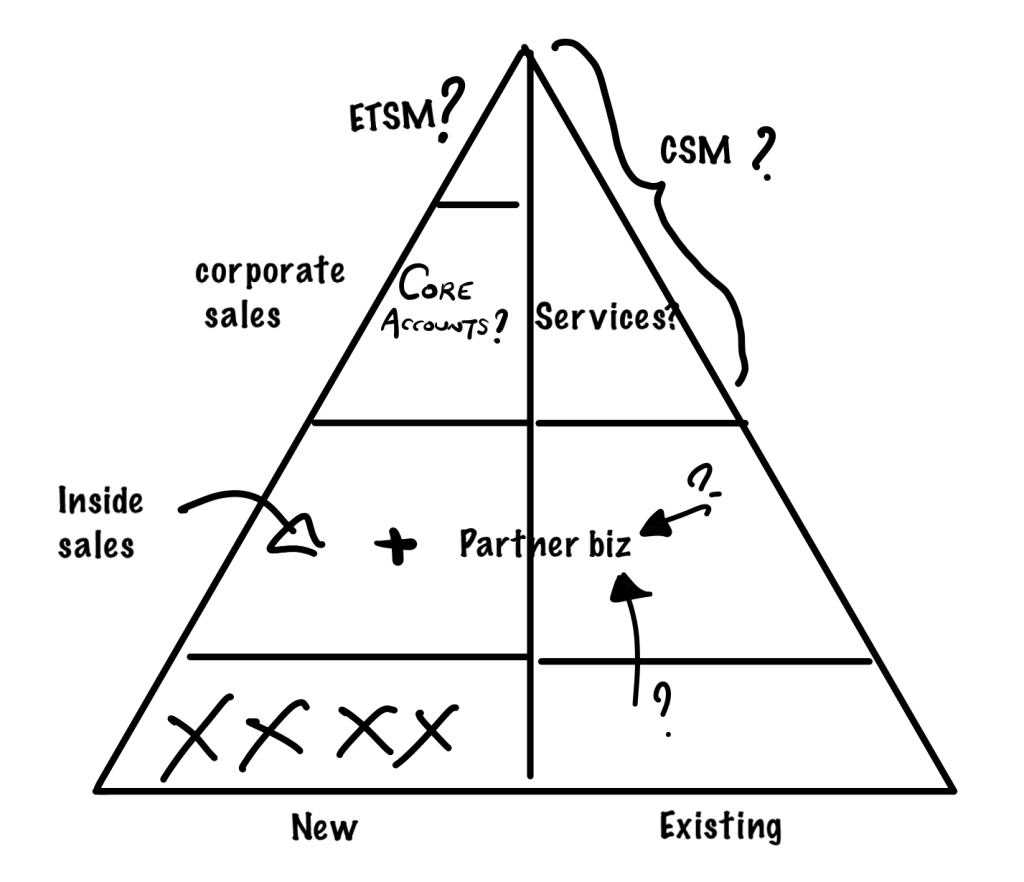
You will know by now that every time you change, tweak or overhaul your GTM model you will fix something, and something else will break.
That is fine. After all you would only make a change that in some way can help you to more efficiently capture a greater part of the market and you’re prepared for some friction on the way.
However, how can you make the right trade-offs and create a balance between disruption and growth? Moreover, this doesn’t just involve sales, it’s your marketing, customer success, lead gen and everyone focused on landing new logos, ensuring retention and upsell.
So how can you achieve that?
HOW WOULD WE APPROACH THE PROBLEM?
- Any meaningful GTM change will likely effect multiple disciplines. This isn’t only a sales show. We would involve other disciplines.
- Review existing practices. What is working, where are the frictions and what has been tried to date?
- Call a spade a spade. From experience we know that what may be perceived as a GTM problem is actually down to sales talent issues or a value mismatch. Keep an open mind.
- From sales tactics, territory design and sales methodology. Through to CRM, BI and further to segmentation, routes to market and geographic focus. A GTM has a huge scope but what is the best approach? Can we achieve more by incremental tweaks or is an overhaul your best bet?
- Help you understand the options, their advantages but also the likely drawbacks to get the balance right.