
PROBLEM #1- PROSPECTS “DON’T GET” YOUR VALUE
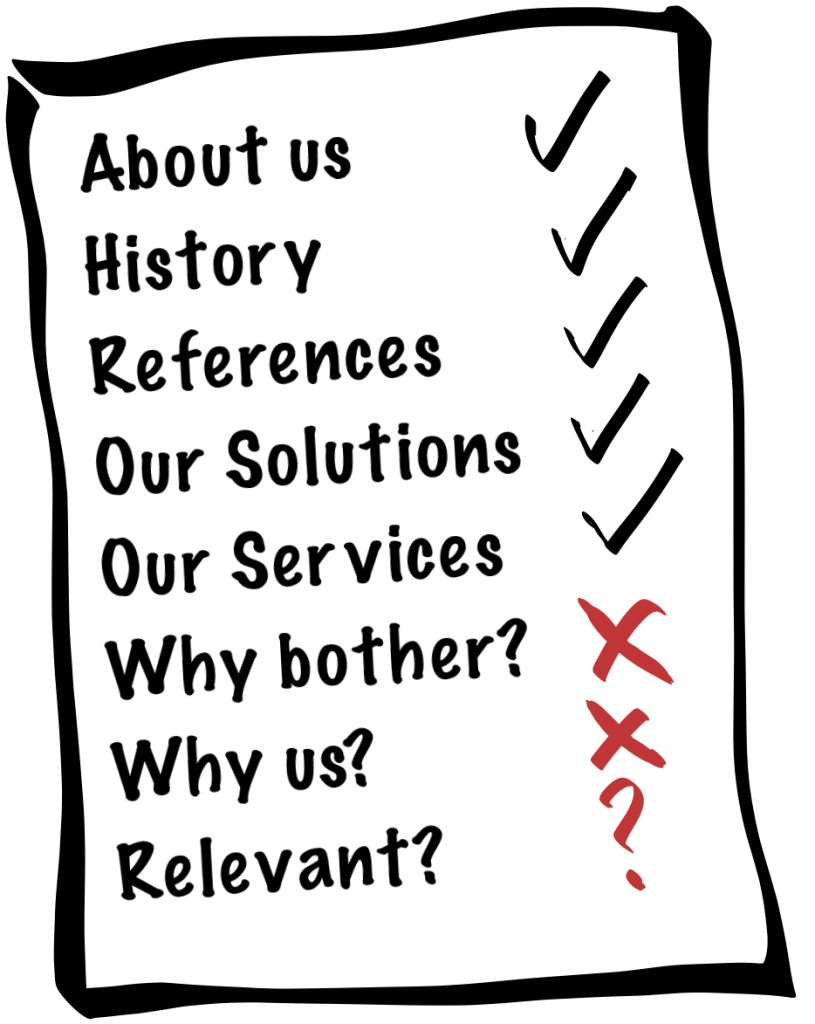
Even after you’ve explained in 20 slides your history, your mission, your office locations, your references, your services and your solutions, they just don’t seem to get it…
The problem is that whilst doing a great job of explaining your solution, you’ve not managed to convince them you know something about their problem. Not only that but you’ve likely just made it worse. Not only do they have their own problem to solve, they’ve now also got to understand your solution, the differences between you and your competition and how both of those options compare to fixing it themselves.
That failure to pivot your pitch to help the buyer navigate their problem only increases the chances of a loss. To either no decision or to an inferior competitor.
WHAT MIGHT SALES LEADERS SEE AS SYMPTOMS OF THE PROBLEM?
- Their solution is so complex that it is difficult for a prospect to understand their value.
- They experience a challenge to onboard and enable their sales team because the topic or solution is complex.
- They are aware of a ‘credibility gap’ in the prospects perceptions of their sellers.
- Their sales pitch is in broadcast mode (“We solve”, “We advise”, “Our solutions”) with low levels of interaction.
- Their sellers can’t succinctly explain why a prospect has a compelling reason to act.
- Their sellers can’t differentiate themselves sufficiently between the competition and/or “do nothing” inaction from the prospect.
PROBLEM #2- YOUR SALES LEADERS DESERVE A LEVEL UP

A good sales leader is going to make themselves available for their teams. They would be capable of handling the day-to-day of forecast, pipeline nurturing, lead funnel sync with marketing, planning for future quarters and of course managing their teams consistently, fairly and in most cases subtly.
A great sales leader should also be getting out there to understand the value chains that drive their business. They will be skilled at coaching each individual based on what they need and possibly even shaping their replacement for when they move up.
But who is coaching them?
LET’S BE HONEST: YOU HAVE TO BE PRETTY SELF-AWARE TO ASK FOR HELP. THAT GOES TWOFOLD FOR MOST SALES LEADERS. BUT GREAT SALES LEADERS MIGHT BE ASKING THEMSELVES:
- How much time do I take to improve myself and how can I prioritise that?
- How do I balance the really important stuff with the ”has to happen now” day-to-day?
- Have I given my sellers so much time that they can’t be self-sufficient? How can I enable them to take more ownership?
- How can I get sellers to take enablement seriously?
- How can I handle a poor performer without disrupting the team?
- How and when can I take control without diminishing my team’s sense of ownership?
PROBLEM #3- GTM CHANGES- BENEFIT VS DISRUPTION

Strong growth, market changes, acquisitions, new propositions, talent recruitment challenges or any other variable makes a change to the GTM part of the job. Equally, if you’ve tried it before you already know that for every change there is a potential benefit, a drawback and of course disruption to your model.
Regardless of the size of the organisation those changes can have a massive impact. But do you go for the big bang with some significant heavy lifting and investment or make incremental changes? Sooner or later you will have to make a decision or risk being left standing.
WHAT MIGHT YOU BE ASKING YOURSELF?
- Would it be more efficient to tackle X segment with inside sales?
- When is the right time to move to hunter/gatherer models and how, with who?
- How can I balance my territory assignments… and how do I handle that rep who has sat on the biggest patch?
- Could I increase lead gen if I outsource? How could I still keep a finger on the pulse?
- How can I get a better understanding of where my leads went? Where are the holes in the bucket?
- What sales methodology would suit my market and proposition the best?
- What data could move my forecast from “an art” to “a science”?